



Quick Answer: There is no single UK grant for commercial solar. Businesses can use tax relief, earn export income through SEG and benefit from other funding routes depending on eligibility, size and location.
Searching for grants for commercial solar panels can make it seem like the UK has a scheme for businesses. In reality, support comes through several different routes. These include tax relief, payments for exported electricity, business rates treatment and certification requirements. Which options apply depends on your business, system and location. Checking the latest rules first can help avoid costly mistakes.
Key Takeaways
- AIA can provide 100% first year tax relief on qualifying solar costs up to £1 million.
- SEG can pay businesses for electricity their solar system exports to the grid.
- Solar installations can affect business rates, depending on their size and how generated electricity is used.
- Finance, leasing and PPAs can reduce the upfront cost where grants are unavailable.
Is There a Direct Government Grant for Commercial Solar Panels?
No, there is no single universal UK government grant that pays a fixed percentage of a commercial solar installation.
Instead, businesses can reduce the financial burden through several separate routes. These include capital allowances, payments for surplus electricity, business rates treatment and certification requirements linked to certain schemes.
That distinction matters when searching for funding. Looking only for a commercial solar grant can mean overlooking support that works through the tax system or energy market instead.
The rest of this guide breaks those routes down so you can see where each one fits.
What Funding Is Actually Available for Commercial Solar in 2026?
Commercial solar funding in 2026 comes through several different mechanisms rather than one application process. The main routes are tax relief, export income, business rates treatment and certification.
Annual Investment Allowance (AIA)
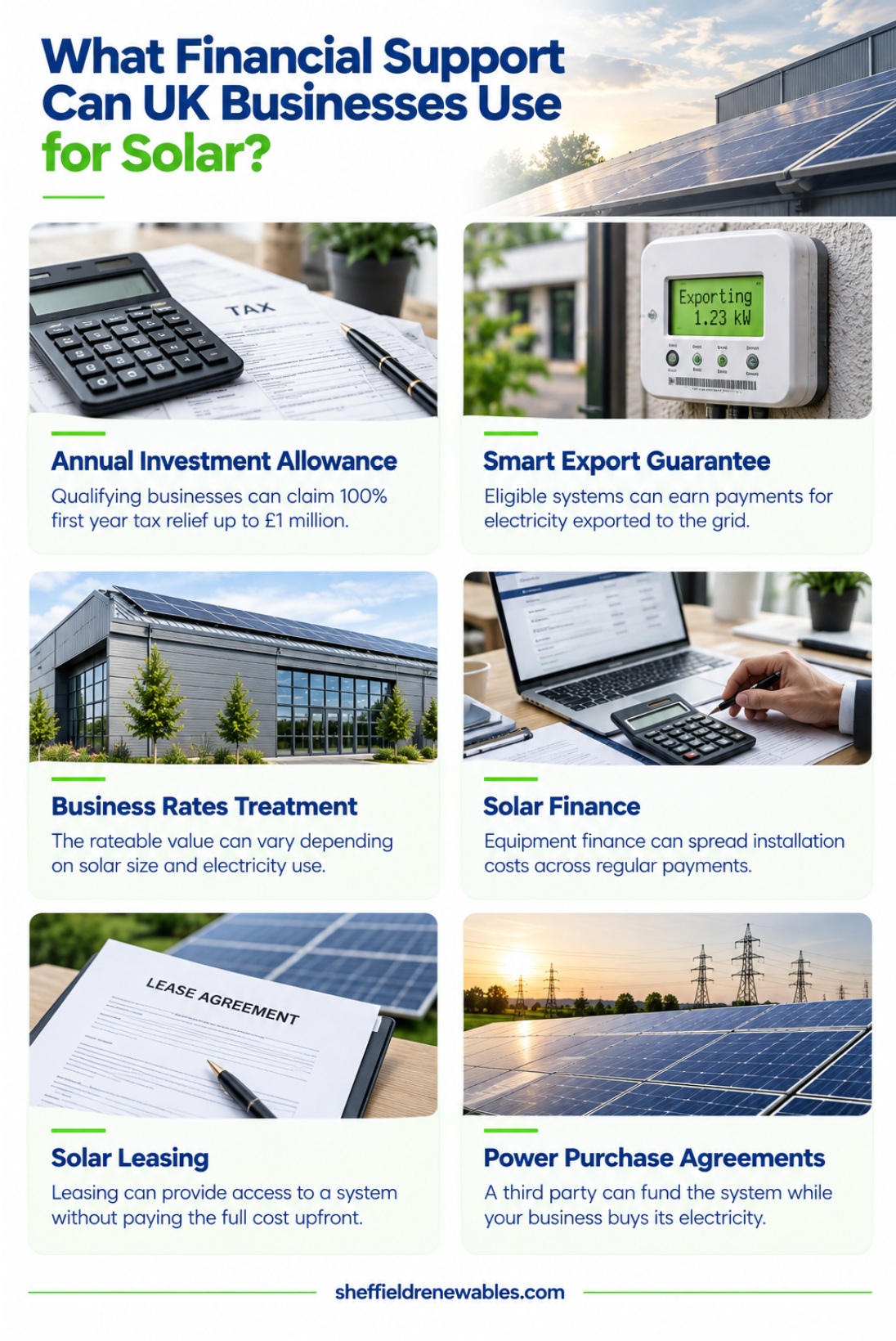
The Annual Investment Allowance can provide 100% first year tax relief on qualifying plant and machinery expenditure, including solar PV. The current AIA limit is £1 million, so a qualifying business can deduct up to £1 million from its taxable profits in the year the expenditure is incurred. HMRC’s Annual Investment Allowance guidance confirms the current £1 million allowance.
Solar PV is treated as a special rate plant and machinery by HMRC. That means it does not qualify for the separate 100% full expensing allowance that applies to qualifying main rate assets. Companies may instead use the 50% special rate First Year Allowance where the relevant conditions are met.
For businesses considering installation, the AIA can make a significant difference to the tax position. That makes it worth discussing the expected spend and accounting treatment before the project is commissioned.
Businesses looking at the practical side of installing a system can also explore our commercial solar panels service.
Smart Export Guarantee (SEG)
The Smart Export Guarantee gives eligible generators a way to receive payment for electricity exported to the grid. Ofgem states that solar PV installations can qualify up to 5MW total installed capacity, provided the other eligibility requirements are met. SEG tariffs must remain above zero, while the supplier sets the tariff rate and contract terms.
This is not a grant paid towards the installation itself. Instead, it can create an ongoing income stream from electricity that the business does not use on site.
Certification also matters. For solar PV installations up to 50kW, suitable certification such as MCS or an equivalent recognised scheme forms part of the SEG eligibility process. Larger systems can fall under the SEG too, but their certification requirements differ.
Business Rates Treatment
Business rates can affect the ongoing cost of a commercial solar system. The Valuation Office Agency considers how solar generation is treated when calculating the rateable value of a non domestic property.
The treatment can vary depending on the size of the installation and how the electricity is used. According to GOV.UK guidance on valuing power generators, solar generation used mainly by the property can be treated differently from generation that is mainly exported. The guidance also sets out how these arrangements are considered when assessing the property.
That makes business rates worth checking before investing. The installation cost is only one part of the financial picture, as the rateable value can also affect the ongoing cost of owning the system.
Certification-Gated Eligibility (MCS)
MCS matters because certification can determine whether a solar installation qualifies for certain support routes. The scheme also provides a recognised framework for installation quality and consumer protection.
MCS currently covers solar PV installations up to 50kW. The MCS certified installation data dashboard records certified small scale renewable installations across the UK.
For SEG purposes, the distinction is important. Solar PV up to 50kW must demonstrate suitable certification, while systems above that level follow different requirements under the scheme. This means system size needs to be established before assuming that an MCS linked route will apply.
Am I Eligible? Key Factors That Affect Commercial Solar Funding
There is no single eligibility test for commercial solar funding. The requirements depend on the type of support, your business, system size and location.
Your electricity use can also affect which option makes sense. A business using a large share of its generation on site may benefit differently from one expecting higher export levels.
Energy costs also help explain the interest in support. According to the ONS analysis of higher energy costs for UK businesses, non domestic electricity prices rose from 14.81p per kWh in Q1 2021 to 28.39p in Q4 2023. They later fell to 25.97p in Q4 2024, still 75% above Q1 2021.
Roof availability is another practical factor. Cushman & Wakefield identified over 1 billion square feet of suitable commercial roof space across UK logistics and industrial properties.
How (and Where) to Check Current Scheme Availability Before Applying
Check the official organisation responsible for the funding route before applying. This is the safest way to confirm whether a scheme is open, who qualifies and what the current requirements are.
For tax relief, start with the latest HMRC guidance. For export payments, check Ofgem and its information on the Smart Export Guarantee. For regional support, look at your local authority, devolved administration or the official body running the programme.
Then check the scheme details carefully. Confirm that applications are currently open, your business is eligible, your type and size of solar installation qualifies, the available funding is still in place and any deadline has not passed.
Pay particular attention to whether approval must be secured before work begins. A scheme that accepted applications in the past may no longer be open. So check the publication or update date on the official guidance before making any commitments.
What Are the Alternatives to Commercial Solar Grants?
A grant is only one way to reduce the financial barrier. Businesses can also spread the installation cost or structure the project around future energy savings.
Commercial Solar Finance and Leasing
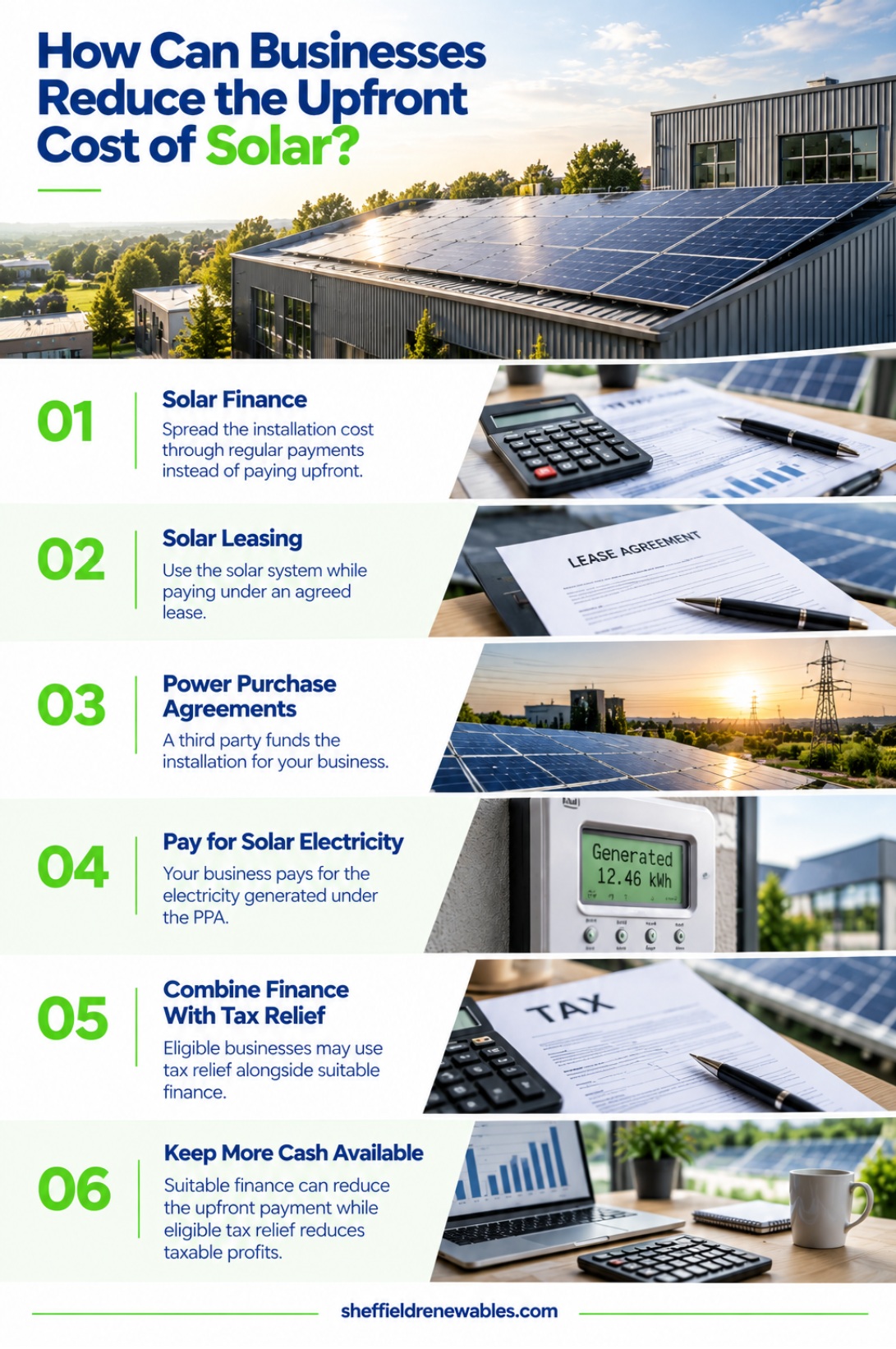
Equipment finance can spread the cost into regular payments rather than requiring the full installation price upfront. Leasing can work in a similar way, allowing a business to use the solar system while paying over an agreed period.
The right arrangement depends on ownership, contract terms and the business’s cash flow.
Power Purchase Agreements for Businesses
A Power Purchase Agreement can allow a business to use solar electricity without buying the system itself. A third party funds the installation, while the business pays for the electricity generated or supplied under the agreement.
This can reduce the initial capital requirement, although the contract should be checked carefully before signing.
Combining Tax Relief With Finance
Finance does not necessarily mean giving up tax relief. An eligible business may be able to use the Annual Investment Allowance alongside a suitable finance arrangement, subject to the specific tax and ownership conditions.
That can reduce taxable profits while avoiding the need to pay the full installation cost in cash at the start.
Can Regional and Local Schemes Differ
Yes, regional support can differ from national funding, because local authorities and regional bodies can run their own programmes, eligibility rules and funding periods.
A business may therefore qualify for a local grant, loan or energy efficiency programme that is not available elsewhere in the UK. Some schemes can support renewable energy projects, while others focus on wider improvements to business premises.
The key point is that local funding needs to be checked separately. Your local authority, devolved administration or regional economic body should have the latest details on current schemes, application deadlines and eligible businesses.
For businesses in South Yorkshire, our commercial solar panels in Barnsley service provides a local option for discussing your site and solar requirements.
FAQs
Is there a government grant for commercial solar panels in the UK?
There is no single universal grant. Businesses can instead use tax relief, export income and other finance routes.
What is the Annual Investment Allowance and how does it apply to solar?
AIA allows qualifying businesses to deduct up to £1 million of eligible expenditure from taxable profits in the year of purchase.
Can businesses earn money from exporting solar electricity?
Yes. Eligible solar generators can receive SEG payments for electricity exported to the grid.
Do commercial solar panels affect business rates?
They can. The treatment depends on factors such as system capacity and how the generated electricity is used.
Can I finance commercial solar panels instead of paying upfront?
Yes. Equipment finance, leasing and PPAs can spread or reduce the upfront cost.
Does funding availability differ by business size or location?
Yes. Eligibility can change according to business type, system size, location and the rules of the specific scheme.
Conclusion
There is no single commercial solar grant in the UK, but businesses still have useful financial support through tax relief, export income, finance and other routes. Eligibility can vary, so check the latest official guidance before committing to an installation.
Considering commercial solar for your business? Contact us to discuss your site’s potential and current funding options.