

Quick Answer: Modern solar panels typically need 1.6 to 2.4 square metres each, meaning roughly 0.4 to 0.6 panels fit per square metre. Real roofs accommodate fewer because of spacing and obstacles.
How many solar panels fit on a roof? The answer begins with panels per square metre, since roof space controls system size, cost, and output. Modern panels use about 1.6 to 2.4 square metres each, or roughly 0.4 to 0.6 per square metre. Actual installations fit fewer due to spacing, edge clearances, and obstacles like chimneys or skylights often present.
Key Takeaways
- Modern solar panels need 1.6 to 2.4 square metres each, fitting roughly 0.4 to 0.6 panels per square metre.
- Usable roof area typically reduces by 20 to 30 percent due to obstructions, edges, and required safety spacing.
- UK homes with 30 to 40 square metres of usable roof space typically accommodate 15 to 20 solar panels.
How Many Solar Panels Fit per Square Metre of Roof
Panel footprints vary depending on cell count and manufacturer, but the typical range for residential installations falls between 1.6 and 2.4 square metres per panel.
The math conversion from panel size to panels per square metre is straightforward. A panel measuring 1.65 square metres means about 0.6 panels fit into each square metre of roof space (because 1 divided by 1.65 equals 0.61).
A larger panel measuring 2.1 to 2.4 square metres means about 0.4 to 0.47 panels fit per square metre. The practical average across different panel sizes works out to roughly 0.5 panels per square metre, which gives a useful rule of thumb for quick estimates before detailed measurements happen.
Quick Reference Table for Panel Sizes and Density
Down below, you can see how different panel sizes translate into panels per square metre and typical power outputs.
| Panel Dimensions (mm) | Area (m²) | Panels per m² | Typical Wattage Range |
|---|---|---|---|
| 1,650 × 995 | 1.64 | 0.61 | 370 to 400 W |
| 1,840 × 1,020 | 1.88 | 0.53 | 400 to 430 W |
| 2,030 × 1,040 | 2.11 | 0.47 | 430 to 460 W |
| 1,134 × 2,093 | 2.37 | 0.42 | 450 to 500 W |
These figures show real panel dimensions from UK installations and the corresponding density you can expect when planning roof layouts.
Latest solar panel efficiency data confirms that modern modules continue increasing power output while physical dimensions remain relatively stable, which means more watts per square metre rather than dramatically smaller panels.
What Affects How Many Solar Panels Can Fit on Your Roof
Roof geometry never equals fully usable space for solar panels because several factors reduce the area available for installation:
- Chimneys, skylights, and vents create exclusion zones where panels cannot be placed.
- Roof edges require safety margins for installation access and wind loading calculations.
- Fire access spacing is mandatory on certain roof types to allow emergency service access routes.
- Roof pitch and orientation determine whether portrait or landscape panel mounting provides better performance and fit.
- Structural capacity or planning restrictions may limit the number of panels, even when physical space appears available.
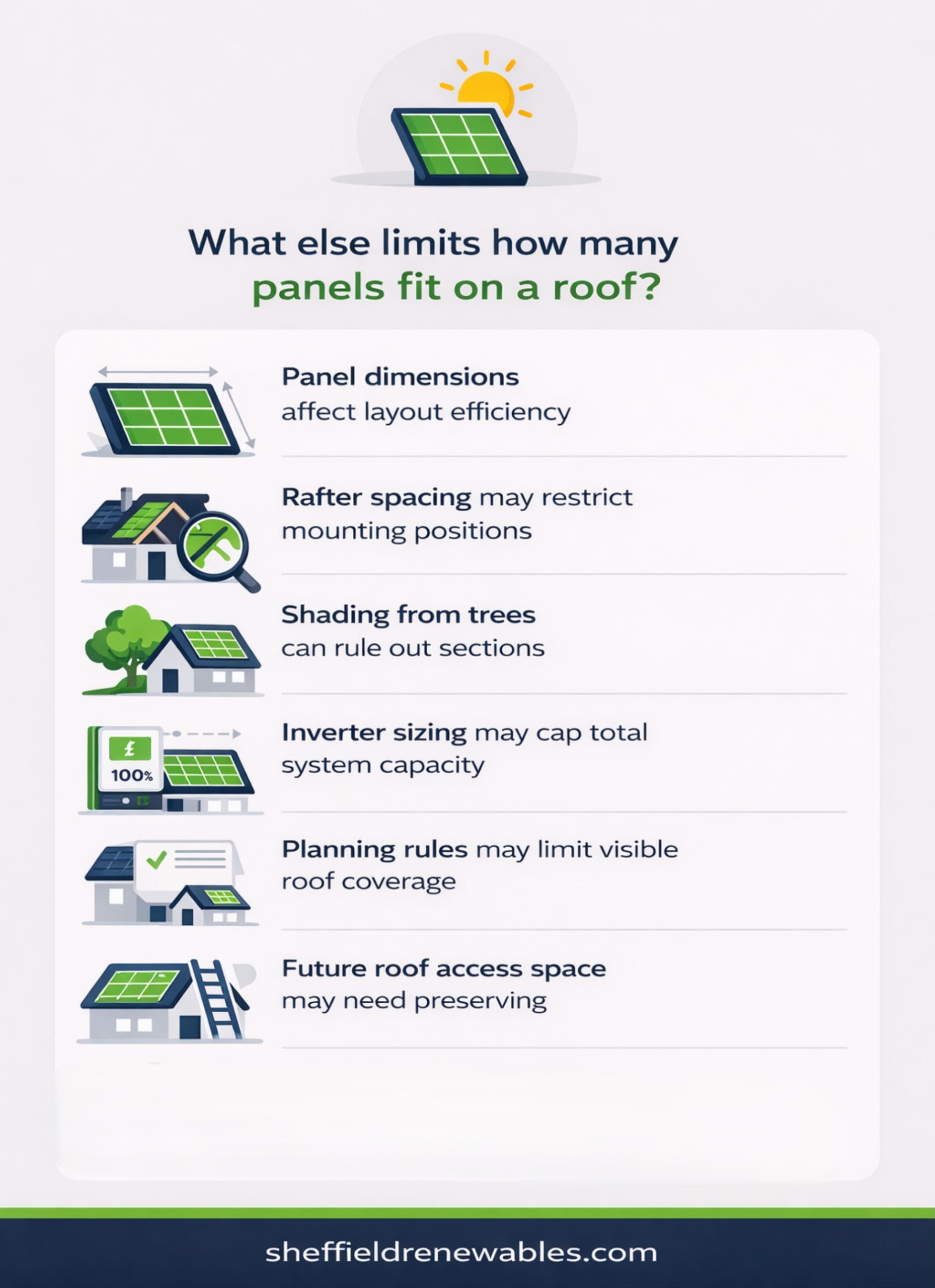
The realistic installer rule expects 20 to 30 percent less usable area than total roof size once all constraints are accounted for in the design.
How to Estimate How Many Solar Panels Your Roof Can Hold
Solar panels typically need about 1.6 to 2.4 square metres of space each, and usable roof area often gets reduced by roughly 20 to 30 percent because of chimneys, skylights, roof edges, and access spacing.
Installers estimate panel numbers by measuring the usable roof surface and dividing it by the footprint of a single panel. This provides a practical early estimate before detailed design work begins.
Here is a simple way to estimate how many solar panels your roof can hold.
Simple Calculation Homeowners Can Use
Measure roof area in square metres by multiplying length and width for each roof plane.
Reduce that figure by 20 to 30 percent to account for unusable space around obstructions and edges.
Multiply the usable area by roughly 0.5 panels per square metre as an average density figure. Round down to whole panels because you cannot install partial modules. A worked example shows how this plays out in practice.
A 50 square metre roof reduces to 35 to 40 square metres of usable space after accounting for chimneys and edge clearances. Multiplying by 0.5 panels per square metre gives approximately 17 to 20 panels as the realistic capacity for that roof size.
You can use our free solar energy calculator to convert your usable roof area into a site-specific kWp and panel count.
How Panel Efficiency Suggests Power per Square Metre
Modern panels deliver approximately 200 to 260 watts per square metre of roof area they occupy. Higher efficiency panels pack more power into the same footprint, but do not dramatically reduce the physical space each panel needs.
Small roofs benefit from high efficiency modules because maximising watts per square metre matters when space constrains system size.
Solar installation guidance from official UK deployment statistics shows that 172,000 new domestic solar installations happened in 2023, with 1.3 gigawatts of capacity added that year, reflecting how homeowners increasingly prioritise efficient use of limited roof space.
Typical Examples of How Many Panels Fit on Different Roof Sizes
Real-world roof sizes translate into specific panel counts that help homeowners understand what their property can accommodate. Different UK housing types show predictable patterns based on typical roof dimensions and usable area after accounting for obstructions.
Here are the realistic ranges for common residential roof sizes across the UK:
- Small terraced or semi-detached homes with about 20m² south-facing roof space usually fit 10–12 panels producing roughly 3.7–4.8kW.
- Medium detached homes with around 35m² usable roof area often support 17–20 panels delivering approximately 6.3–8kW capacity.
- Large detached homes with multiple suitable roof planes around 50m² can accommodate 24–28 panels producing roughly 8.9–11.2kW.
- Bungalows with large single roof slopes sometimes fit more panels because continuous space allows denser layouts beyond 60m².
- Commercial or agricultural buildings with open roof spans often install far more panels due to structural capacity.
Rooftop solar potential research from UCL Energy Institute estimates up to 117 gigawatts of technical potential exists on rooftops and developed spaces in England alone, showing enormous untapped capacity remains across UK properties.
Spacing and Layout Considerations for Different Roof Types
Different roof configurations require different spacing approaches, which directly affects how many panels ultimately fit within the available area.
Below are the typical spacing rules that installers follow when designing layouts for different roof types.
| Roof Type | Typical Panel Spacing | Effective Panels per m² | Key Layout Consideration |
|---|---|---|---|
| Pitched roof (30 to 45 degrees) | Minimal gaps (standard mounting rails) | 0.45 to 0.55 | Panels follow roof angle, minimal self-shading |
| Flat roof (tilt frames) | Row spacing 1.5 to 2.5 times panel height | 0.25 to 0.35 | Prevent winter shading between rows |
| East or west-facing pitched | Standard spacing | 0.45 to 0.55 | Output reduced but density unchanged |
| Complex multi-plane roofs | Variable gaps around junctions | 0.30 to 0.45 | Extra losses at hips, valleys, and plane changes |
Solar roof spacing recommendations from BRE guidance explain row spacing calculations for flat roofs and the trade offs between maximising panel count versus avoiding shading losses.
Commercial installations often use sophisticated shading analysis software to optimise row spacing, while residential pitched roofs typically achieve better packing density because self-shading rarely becomes a constraint.
Conclusion
Roofs usually fit about half a panel per square metre after spacing and obstacles. Usable roof area matters more than total size, and professional layout design provides the most accurate capacity estimate.
Get a free solar roof assessment and quote today to find out exactly how many panels your roof can accommodate, what system size makes sense, and what energy output you can expect from your property.
FAQs
How many square metres does one solar panel need?
One solar panel typically needs 1.6 to 2.4 square metres depending on the specific model. Standard residential panels average around 1.7 to 1.9 square metres per panel.
Can I cover my whole roof with solar panels?
No, because chimneys, skylights, vents, roof edges, and fire access spacing reduce usable area by around 20 to 30 percent compared to total geometric roof size.
How many panels fit on a typical UK home roof?
A typical UK home with 30 to 40 square metres of usable south facing roof space fits approximately 15 to 20 panels, producing 5.5 to 8 kilowatts peak capacity.
Do higher efficiency solar panels take less space?
Higher efficiency panels deliver slightly more power per square metre but physical panel dimensions remain similar across efficiency ranges, so space savings are minimal compared to power gains.
Is there a minimum roof size for solar panels?
Even 10 to 15 square metres of usable space can support a small system of 5 to 8 panels, which still delivers meaningful electricity generation and bill savings for smaller properties.