

To run a typical UK 3-bedroom home off-grid, you'll need around 8–13 solar panels (350W each) for summer use, but 50–70 panels (plus battery storage) for year-round autonomy, due to limited winter sunlight.
The dream of energy independence is becoming increasingly appealing to UK homeowners. With rising energy costs and growing environmental concerns, many are exploring off-grid solar solutions. But exactly how many solar panels would you need to completely disconnect from the grid? Let’s explore the key factors, calculations, and practical considerations for making this significant step towards energy self-sufficiency.
Key Takeaways
- Off-grid solar systems in the UK require significantly more panels for winter than summer. A typical 3-bedroom home needs 10-15 panels for summer but 50-70 panels for winter autonomy.
- Battery storage is essential, plan for 2-3 days of energy backup (24-36kWh for average homes) to maintain power during periods of low sunlight.
- Consider alternatives like hybrid systems or partial independence if full off-grid living isn’t practical due to space limitations or cost concerns.
How Many Solar Panels Do You Need to Live Off-Grid?
Going off-grid requires careful planning. Unlike grid-tied systems, where you can draw electricity when needed, an off-grid setup must generate all your power independently.
The number of solar panels you’ll need depends on four critical factors:
Your energy consumption: How much electricity your household typically uses daily, measured in kilowatt-hours (kWh).
Battery storage capacity: How much power you can store for nights and cloudy days.
Solar panel output: The electricity generation capacity of each panel, typically ranging from 250W to 400W for residential panels.
UK solar exposure: The amount of sunlight your location receives throughout the year.
The average UK home consumes around 2,700 kWh of electricity annually. This translates to approximately 7.4 kWh per day, though this varies considerably based on household size, appliances, and usage patterns.

Is It Really Possible to Live Off-Grid in the UK?
Yes, but with some important conditions.
Our northern latitude means winter days are short with minimal sunshine. December and January typically offer only 7-8 hours of daylight, with actual peak sunlight hours being considerably fewer due to cloud cover.
During winter months, a solar system that performs brilliantly in summer might generate less than 20% of its rated capacity. This stark seasonal variation means systems must be significantly oversized to cope with winter demands.
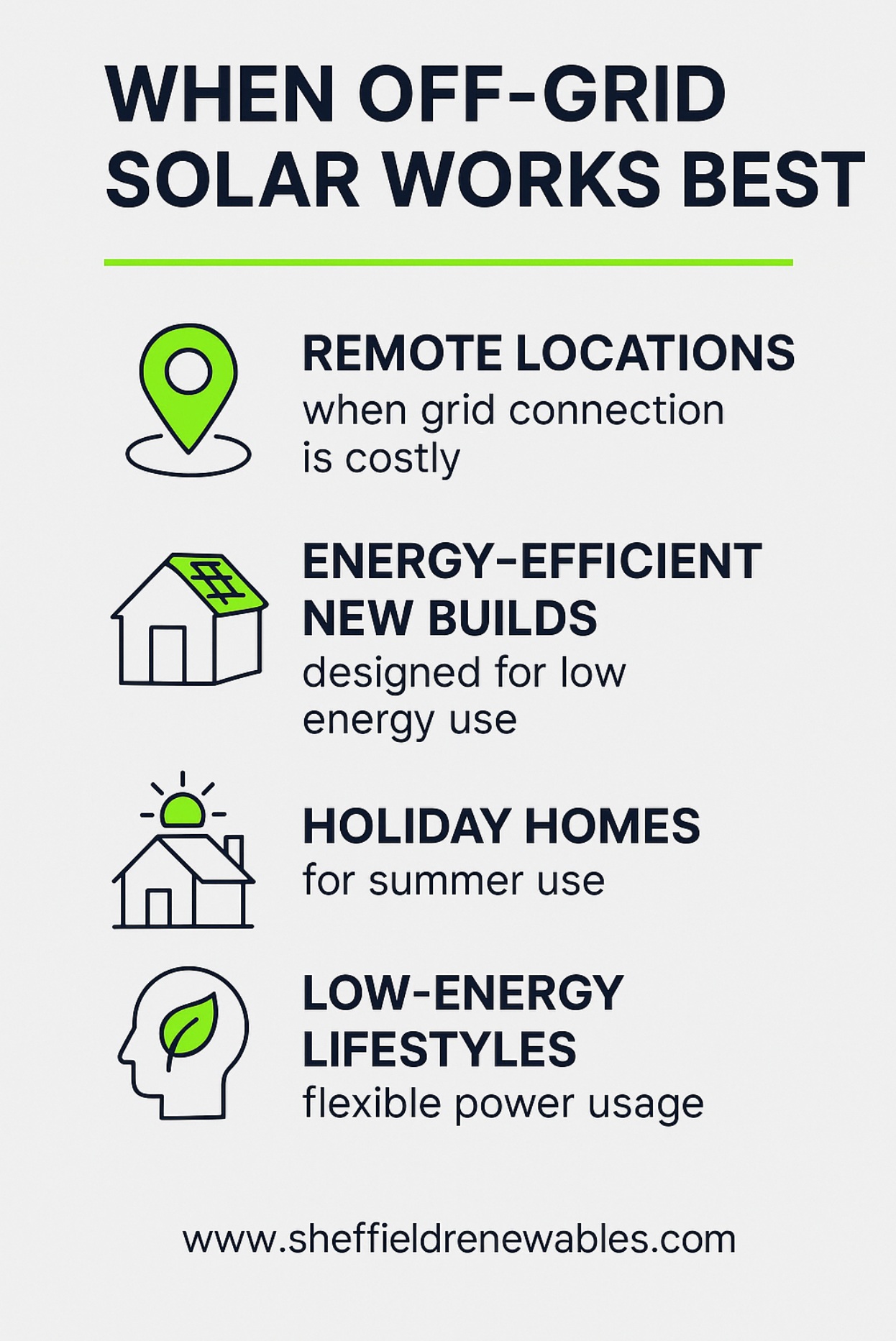
Despite these challenges, some UK households have successfully gone off-grid. And it is most feasible for remote homes where grid access is costly, eco-houses built for efficiency, and households willing to adapt their energy use to seasonal availability.
How to Calculate How Many Solar Panels You Need
Determining your solar panel requirements involves a systematic approach:
Step 1: Calculate Your Daily Energy Consumption
Start by reviewing your electricity bills to find your annual usage. For example, if you use 2,700 kWh annually:
2,700 kWh ÷ 365 days = 7.4 kWh per day
For a more accurate assessment, consider seasonal variations. Winter consumption is typically higher due to increased lighting and heating needs.
Step 2: Factor in Battery Storage Requirements
For off-grid living, you’ll need batteries to store excess energy. The general rule for the UK is to have enough storage for 2-3 days of typical usage.
For a home using 8 kWh daily: 8 kWh × 3 days = 24 kWh minimum battery capacity
Step 3: Calculate Panel Requirements
A typical 350W solar panel in the UK generates approximately 300-350 kWh annually, or about 0.8-0.9 kWh per day when averaged across the year.
To produce 8 kWh daily: 8 kWh ÷ 0.85 kWh per panel = 9.4 panels (round up to 10)
However, this basic calculation doesn’t account for seasonal variations or inefficiencies.
Step 4: Adjust for Winter Performance
In December and January, your solar generation might drop to 20% of summer levels. To ensure year-round sufficiency:
8 kWh ÷ (0.85 kWh × 0.2) = 47 panels for winter autonomy
This is why many off-grid enthusiasts supplement with other energy sources during winter.
| Home Size | Daily Usage | Panels Needed (Summer) | Panels Needed (Winter) | Battery Storage |
|---|---|---|---|---|
| 2-bedroom | 5–7 kWh | 6–9 panels | 30–40 panels | 15–21 kWh |
| 3-bedroom | 8–12 kWh | 10–15 panels | 50–70 panels | 24–36 kWh |
| 4–5 bedroom | 13–16 kWh | 16–20 panels | 80–100 panels | 39–48 kWh |
Winter Planning for Off-Grid Systems
Winter presents the greatest challenge for off-grid solar in the UK. December solar production can be just 10-15% of summer levels.
To maintain reliable power through winter:
- Size your array larger than your immediate needs. Many successful UK off-grid homes install 25-50% more capacity than basic calculations suggest.
- Invest in substantial battery storage. A home using 8 kWh daily may need 26 kWh or more of battery capacity to cover multiple cloudy days.
- Consider a small backup generator for emergency use during extended poor weather.
When Is Off-Grid Solar a Good Option?
Alternative Solutions If Full Off-Grid Isn't Feasible
If complete energy independence seems impractical for your situation, consider these alternatives:
Grid-Tied Solar with Battery Backup
This increasingly popular option maintains grid connection while providing partial independence. You’ll have power during outages and can optimise self-consumption of solar energy.
A typical system might include 8-13 panels and a 5-10 kWh battery, costing £7,000-£10,000 installed.
Smart Export Guarantee (SEG) Systems
Standard grid-tied solar without batteries still offers financial benefits through the UK’s Smart Export Guarantee. You’ll receive payment for excess electricity exported to the grid, though you won’t have power during outages.
Partial Independence Solutions
Some homeowners create hybrid systems where essential circuits (refrigeration, heating, basic lighting) can run off-grid, while higher-consumption appliances remain grid-connected.
This approach balances resilience with practicality and typically costs 30-40% less than full off-grid systems.
Conclusion
Going off-grid in the UK is challenging but achievable with proper planning and realistic expectations. While the ideal system varies for each household, understanding your energy needs is the crucial first step.
Our team of solar experts can provide a personalised assessment based on your specific requirements and location. Contact our solar specialists today for a free consultation and discover the perfect solar solution for your energy independence journey.
Frequently Asked Questions
Is it worth going off-grid with solar in the UK?
For most urban homes with existing grid connections, a hybrid system makes more economic sense. Full off-grid living is most cost-effective for remote properties or purpose-built eco-homes. The typical payback period for a grid-tied system is now around 10 years, while off-grid systems should be viewed as infrastructure investments rather than purely financial decisions.
What happens if I run out of stored power?
Without grid connection, you’ll need a backup plan. Options include generators, reducing consumption, or designing redundancy into your system with oversized battery banks. Many off-grid households develop energy awareness and adapt usage patterns to available supply.
How much roof space do I need for off-grid solar?
A typical 350W panel measures approximately 1.7m² in area. For a 3-bedroom home needing around 10 panels for summer use, you’d need about 17m² of suitable roof space. For winter-optimised systems requiring 50+ panels, ground-mounted arrays often become necessary.
Can I go off-grid with just solar panels and no battery?
No. Batteries are essential for off-grid systems to provide power during nights and cloudy periods. Without storage, you’d only have electricity when the sun is shining.
What size battery do I need to live off-grid in winter?
For winter living, battery capacity should cover at least 3 days of typical usage. For a household using 8 kWh daily, that means at least 24 kWh of storage. Many successful off-grid homes install 25-30 kWh of battery capacity to ensure reliability during extended periods of low generation.