
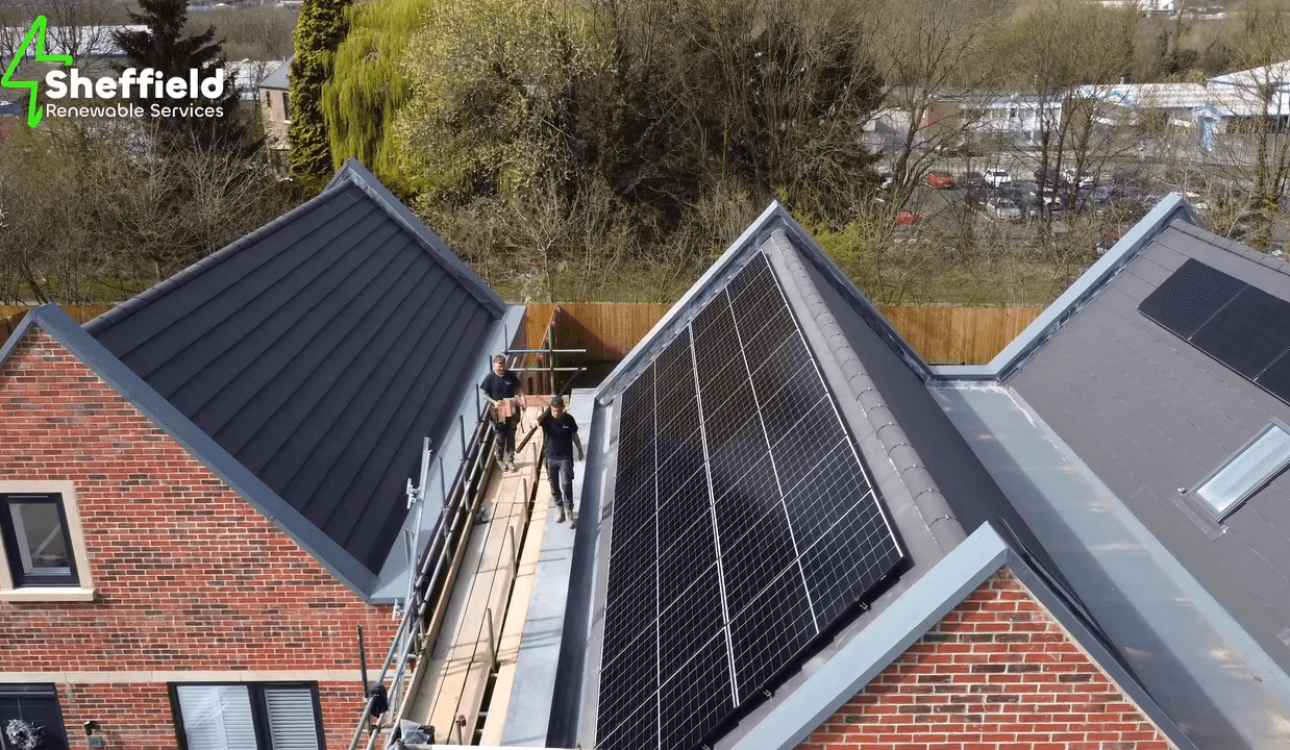

This guide provides a clear overview of how solar works, what it costs, how much energy you can generate, and whether it is suitable for your home. For more detailed explanations, you can explore the dedicated guides linked throughout this page.
How Solar Panels Work
Solar PV panels generate electricity from daylight rather than direct sunshine alone. When light reaches the photovoltaic cells inside a panel, electricity is produced and passed through an inverter, which converts it into a usable form for household appliances. Any electricity that is not used at the time of generation can either be exported to the grid or stored in a battery, depending on how the system is designed.
Generating electricity on-site can reduce dependence on grid-supplied power, which is explained further in this comparison of solar energy versus grid electricity.
Solar panels operate throughout the year in the UK, although output is higher during spring and summer due to longer daylight hours.

Do solar panels work on cloudy days?
Solar panels generate electricity from daylight rather than direct sunshine, so they continue to work on cloudy days, although output is lower than on clear days.
Do solar panels generate electricity in winter?
Solar panels operate throughout the year in the UK, but shorter daylight hours and lower sun angles mean generation is typically lower in winter.
What types of solar panels are available for homes?
Most UK homes use monocrystalline solar panels, which offer higher efficiency. Polycrystalline panels are less common on new installs, while thin-film panels are typically used on specialist or non-standard surfaces.
What is the role of the inverter in a solar system?
The inverter converts the electricity produced by the panels into a form that household appliances can use safely and efficiently.
What happens to electricity that isn’t used straight away?
Unused electricity can be exported to the grid or stored in a battery if one is installed, allowing it to be used later when the panels are not generating.
Are Solar Panels Worth It?
Whether solar panels are worthwhile depends on factors such as household electricity usage, roof suitability and how much generated electricity is used within the home. For many UK households, solar panels deliver long-term financial benefits by reducing electricity bills and generating income from surplus energy exported through the Smart Export Guarantee (SEG).
Modern solar systems are designed to last 25 years or more, meaning households can continue benefiting well beyond the point where the system has paid for itself.
Are solar panels suitable for most UK homes?
Solar panels can be a good option for many UK properties, particularly where there is suitable roof space and regular daytime electricity use.
Do solar panels make sense without installing a battery?
Many homes see benefits from solar panels alone by using electricity as it is generated and exporting unused energy to the grid.
How quickly can solar panels start delivering savings?
Savings usually begin as soon as the system is operational, with long-term benefits increasing as reliance on grid electricity is reduced.
Can solar panels help reduce exposure to rising energy costs?
Generating electricity at home can reduce dependence on supplier pricing, helping households manage future energy cost increases.
Are solar panels designed to provide long-term value?
Modern solar systems are built for long service lives, allowing households to continue benefiting for decades after installation.
Solar Panel Costs and Payback
Solar installation costs vary depending on system size, panel specification, inverter choice and whether battery storage is included. Rather than focusing solely on upfront cost, many homeowners consider the payback period — the time required for bill savings and export payments to offset the initial installation cost.
In the UK, typical solar panel payback periods often fall between 8 and 12 years, depending on electricity usage patterns and how much solar energy is self-consumed.
What factors influence the cost of solar panels?
Solar installation costs are mainly influenced by system size (kW), panel efficiency, inverter type, roof access and whether battery storage is included. Most domestic systems fall within a typical UK range for small to medium household installations.
What does “solar panel payback period” mean?
The payback period refers to the number of years it takes for electricity bill savings and export income to equal the original installation cost.
How long does it usually take for solar panels to pay for themselves in the UK?
For many UK households, solar panel payback commonly falls between 8 and 12 years, depending on electricity usage, system size and how much energy is used within the home.
How does self-consumption affect solar payback?
Homes that use a higher proportion of the electricity they generate typically see faster payback, as self-used solar power offsets higher grid electricity prices.
Do export payments improve the return on investment (ROI)?
Payments received through the Smart Export Guarantee (SEG) contribute to overall returns, although using solar electricity directly in the home usually provides greater financial benefit than exporting it.
Select your house size to see an estimated cost and savings with solar panels.
House size:
Battery:
Include battery (5.2kWh)
Battery storage helps you use more of your solar energy and increase savings over time.
 Cost & savings
Costs and savings depend on house size, system size, solar generation, optional battery storage, and typical energy usage. This estimate shows how we calculate expected costs and savings.
-
This solar system could cost:
£7,016 -
Estimated yearly electricity bill savings:
£630 -
Estimated payback period:
11 years
 With finance
Spread the cost of your solar system with finance from our approved lending partners. All finance is subject to eligibility, approval, and applicable terms and conditions.
-
Over 5 years
£138 per month
-
Over 10 years
£86 per month
-
Over 20 years
£62 per month
Example finance illustration: Total order value: £10000. Loan duration: 10 years. Upfront deposit: £500. Total amount of credit: £9500. Representative APR: 9.9%. Rate of interest: 9.5% (fixed). Total cost of credit: £5262.4. Total amount payable: £15262.4. Monthly payment: £123.02.
How Many Solar Panels Do I Need?
The number of solar panels your home requires is influenced by several factors, including your annual electricity usage, available roof space, roof orientation, and the output rating of the panels installed. Thanks to improvements in solar technology, today’s panels generate more electricity per square metre than older systems, meaning fewer panels are often needed to achieve the same results.
Typical UK Solar Panel Requirements
For most UK households, a solar installation usually consists of around 6 to 12 panels. This range suits the average home’s electricity demand and provides a practical balance between energy generation, roof space, and installation cost. Homes with higher daytime electricity use or electric heating may benefit from additional panels, while smaller properties often require fewer.
To understand what system size is most suitable for your property and energy usage, read more about how many solar panels you need.
Where can I install solar panels?
Solar panels can be installed in several locations on a property, provided the site receives sufficient daylight, can support the system structurally, and meets planning and electrical requirements. While pitched roofs are the most common location, solar panels may also be installed on flat roofs, the ground, or certain outbuildings where conditions allow.
The most suitable location is one that offers consistent daylight throughout the year, minimal shading, and space to install panels at an appropriate angle.
Can I install solar panels on my roof?
In most cases, yes. Pitched roofs are the most popular choice because they already provide an angle that works well for solar panels. Panels are fixed above the roof covering using mounting systems designed to keep the roof weatherproof.
South-facing roofs tend to generate the most electricity overall, but that doesn’t mean other roof directions can’t work. East- and west-facing roofs can still produce useful amounts of power, especially if you use more electricity in the morning or evening.
Can solar panels be installed on a flat roof?
Flat roofs can also be suitable. Solar panels are usually installed on angled frames that tilt them towards the sun. These setups are commonly used on extensions, garages and similar spaces.
The system needs to be carefully designed so the panels don’t shade each other and remain secure in windy conditions.
Can I install solar panels in my garden or on the ground?
Yes, ground-mounted solar panels are an option if you have enough outdoor space. These systems sit on frames fixed into the ground and can be positioned to face the sun directly. Ground-mounted panels can be very effective, but they’re more likely to involve planning considerations, especially if the system is large or visible from surrounding areas.
Can solar panels be installed on garages, sheds or outbuildings?
Sometimes. Solar panels can be installed on garages, sheds or other outbuildings if the structure is strong enough and gets enough daylight. The distance to your main electricity supply also matters, as the system needs to be safely connected back to your home. A site survey is usually needed to confirm whether an outbuilding is suitable.
Are wall-mounted solar panels an option?
In some situations, yes, but this is less common. Panels mounted on walls usually produce less electricity than roof-mounted systems because they receive less direct sunlight, particularly during winter. Wall installations also need to meet visual and planning requirements, which can limit where they’re suitable.
Panel Position, Roof Angle and Efficiency
Solar panel output is shaped by a combination of roof orientation, installation angle, and panel efficiency. In the UK, these factors determine how much sunlight panels capture across the year rather than relying on peak summer conditions alone.
South-facing roofs typically produce the highest annual generation because they receive consistent sunlight throughout the day. However, east- and west-facing systems can still deliver strong performance when designed correctly, particularly for households that use more electricity in the morning or evening.
Why Efficiency and Angle Matter
Panel efficiency influences how much electricity can be produced from limited roof space, while the roof’s pitch affects how effectively panels absorb sunlight during different seasons. Modern high-efficiency panels can compensate for less-than-ideal orientations, making solar viable for a wider range of UK properties than in the past.
For a more detailed look at how roof angle impacts solar performance in the UK, you can read more about optimal solar panel angles. If roof space is a concern, it’s also worth exploring how solar panel efficiency affects system output
What Happens to Surplus Solar Energy?
At certain times of day, your solar panels will generate more electricity than your home needs. This usually happens during daylight hours when demand is low, such as when you’re out at work. If that extra energy isn’t managed properly, it would simply be sent back to the grid — but homeowners now have several practical options.
If you have battery storage, surplus electricity can be stored and used later in the evening, helping to reduce reliance on grid power when solar generation drops. If a battery isn’t installed, excess energy can be exported to the national grid, where it may earn payments through the Smart Export Guarantee (SEG), depending on your tariff and supplier.
Some households use a combination of both approaches, storing part of the surplus while exporting the rest. The best option depends on your electricity usage patterns, system size, and whether maximising savings or flexibility is the priority.
If you’re unsure what happens to excess solar energy in real-world use, or how batteries and export payments compare, you can read more about what happens to surplus solar energy.
Smart Export Guarantee (SEG) — Selling Surplus Solar Electricity
The Smart Export Guarantee (SEG) is a government-backed scheme that requires licensed electricity suppliers to offer payments for renewable electricity exported to the national grid. Households with solar PV systems can receive payments for each unit of electricity they export, provided eligibility requirements are met.
Under SEG:
- You are paid for electricity you do not use yourself and export to the grid
- Export rates are set by individual suppliers and can vary over time
- Solar PV systems typically need to be certified and have appropriate export metering in place
Export income depends on your chosen tariff and how much electricity your system exports.
Planning Permission for Solar Panels (UK Homeowners)
In most cases, you do not need planning permission to install solar panels on your home in the UK. Roof-mounted solar PV and solar thermal panels are generally allowed under permitted development rights, provided certain conditions are met. This means installation can usually go ahead without applying to the local planning authority.
When planning permission is not required
Domestic solar panels fitted to the roof or wall of a private house are usually classed as permitted development and do not require planning permission, as long as the panels:
- Are installed so they sit close to the roof surface
- Do not exceed projection limits set out in planning rules
- Minimise visual impact as far as reasonably practicable
These conditions are intended to ensure solar installations remain proportionate and visually unobtrusive.
When planning permission may be needed
There are important exceptions where planning permission or listed building consent may be required. This typically applies if:
- The property is a listed building
- The installation is within a conservation area, National Park or other protected designation
- Panels would significantly alter the external appearance of the building or exceed permitted development limits
Even in conservation areas, roof-mounted solar panels may still be allowed in many situations. However, listed building consent is always required for historic properties.
Planning conditions to be aware of
National planning rules also require that solar equipment:
- Is positioned to minimise its effect on the appearance of the building
- Is removed when no longer needed
These conditions apply to ensure installations remain appropriate over the long term.
Can I get a solar panel grant?
There are no specific UK Government grants solely for installing solar panels. However, support may be available through broader energy efficiency schemes, depending on your household circumstances, property type and location. It’s also worth checking with your energy supplier to see whether they offer incentives or export tariffs linked to solar generation.
For England and Wales
Financial support may be available through the Energy Company Obligation (ECO) scheme, which is designed to help eligible households improve their home’s energy efficiency. You can find out more by contacting your local council or energy supplier.
For Scotland
Scotland operates its own funding and loan schemes for home energy improvements. Depending on eligibility, support may be available for renewable technologies, including solar panels.
For Northern Ireland
Northern Ireland does not operate the same schemes as the rest of the UK. Homeowners should contact NI Energy Advice for guidance on what support or funding options may be available locally.
Off-Grid Solar and Special Cases
Running a home entirely off-grid is possible, but it requires careful planning. Off-grid systems usually need more solar panels and larger battery storage than grid-connected systems to ensure electricity is available at all times. In the UK, shorter winter days and lower sunlight levels make off-grid setups more demanding, as systems must be sized to cope with reduced generation.
If you’re considering an off-grid system or want to understand how many panels and batteries would be required, you can read more about how many solar panels are needed to run a home off-grid.
Solar Panel Lifespan and Maintenance
Solar panels installed on UK homes are designed to operate for 25 years or more, with most manufacturers offering long-term performance warranties. The solar inverter, which converts electricity into a usable form for household appliances, typically has a shorter lifespan and may need replacing after around 10–15 years.
In terms of maintenance:
- Solar panels require very little ongoing upkeep
- UK rainfall usually helps keep panels clean when they are installed at a suitable angle
- Occasional cleaning may be needed if panels are heavily shaded, close to trees, or ground-mounted
Installers should provide written guidance on basic system checks, monitoring and fault indicators following installation.
EPC Rules and Regulations for Landlords
Energy Performance Certificates (EPCs) show how energy-efficient a rental property is, based on factors such as insulation, heating systems and renewable energy use. Current regulations require landlords in England and Wales to work towards achieving an EPC rating of C or above for rented homes by 2030.
Installing solar panels can help improve a property’s EPC rating by reducing reliance on grid electricity and lowering estimated energy costs. For landlords, this can support compliance with future regulations while also improving the long-term efficiency and appeal of the property.
For a detailed explanation of upcoming requirements and how they may affect rental properties, you can read more about the new EPC rules for landlords.
Conclusion
Every home is different. Factors such as roof size, orientation, household electricity use and location all affect system size, installation costs and potential savings.
To see personalised estimates based on your property, you can use our solar panel calculator to explore likely costs, savings and payback time before speaking to an installer.