

Quick Answer: Surplus solar energy is stored in batteries, exported to the grid for payment through SEG tariffs, or limited by the inverter when generation exceeds system or grid limits.
It’s a sunny afternoon and your solar panels are working overtime, churning out way more electricity than your kettle and fridge are using. So where does all that extra energy actually go? Can you sell it? Does it just disappear? Getting your head around surplus solar is key to squeezing every penny out of your investment, whether that’s through export tariffs, battery storage, or smart system design.
Key Takeaways
- Oversizing your solar system increases annual output by capturing more generation during low-light months and shoulder hours, even if some midday surplus gets exported or clipped.
- Without battery storage, UK homes typically self-consume only 29-39% of their solar generation, meaning 60-70% becomes valuable surplus that can earn SEG income.
- Battery storage can double your self-consumption to 70-90%, saving you far more money by avoiding 24-30 p/kWh import costs than you’d earn from exporting at 4-40 p/kWh.
Why Do Solar Panels Produce More Energy Than You Use?
Solar panels don’t care about your schedule. They generate peak power during midday and summer months, precisely when most households use the least electricity. You’re at work, the kids are at school, and apart from your fridge quietly doing its thing, demand is minimal.
This creates a natural mismatch between generation and consumption.
Loads of installers deliberately go bigger with solar arrays than your typical daytime consumption needs. It’s because it maximises annual output across all seasons and times of day. An oversized system captures significantly more generation during winter months, early mornings, and late afternoons when the sun sits lower and conditions are less than perfect.
Going smaller saves money upfront but sacrifices crucial low-light generation when you actually need power most. You end up importing expensive grid electricity precisely when you hoped to be self-sufficient.
The 20% Rule Explained
The 20% rule gets mentioned a lot, but in the UK it really just comes down to DNO export limits.
- It originally comes from US electrical rules, allowing modest system oversizing.
- Most UK homes are limited to 3.68 kW export per phase (some now allow 5 kW).
- You can fit more panels than this, but the inverter caps export and clips anything above the limit.
That’s why UK systems are often oversized on the roof but export-limited in practice.
What Happens to Excess Solar Energy?
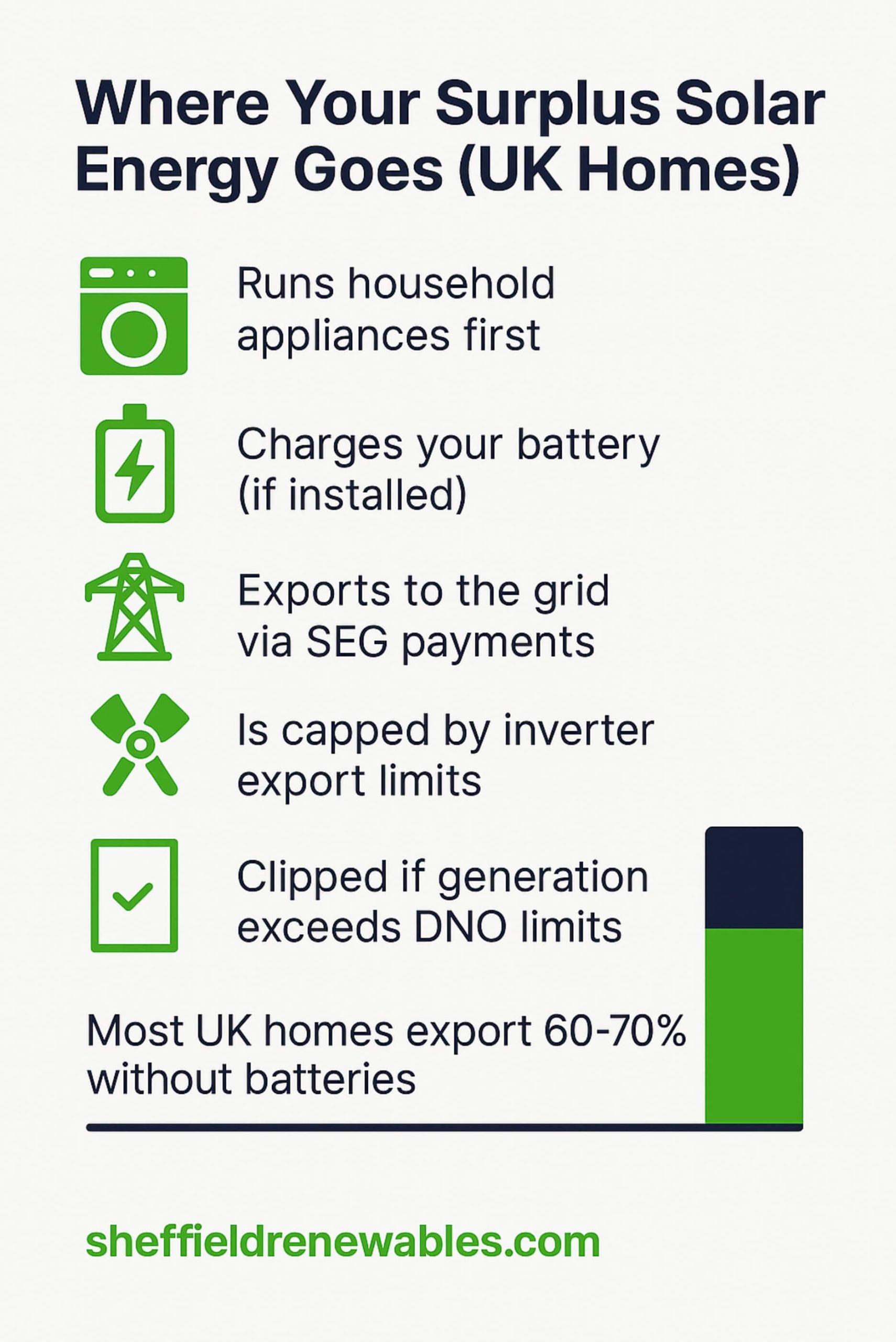
When your panels generate more electricity than your home needs, the surplus takes a straightforward route. Solar panels make DC power. Your inverter converts this to AC. The electricity flows into your home to cover immediate demand.
Any remaining surplus automatically flows back through your meter into the local distribution network.
According to MCS modelling data, a “home all day” household self-consumes roughly 29% of total solar generation. A household “in half the day” does slightly better at 39%. Why so low? Midday generation peaks precisely when demand drops.
The remaining 60-70% becomes surplus.
Export to the Grid and the Smart Export Guarantee
The Smart Export Guarantee provides the legal framework for selling surplus solar back to the grid. Established by statutory instrument SI 2019/1005 and administered by Ofgem, SEG requires energy suppliers with 150,000+ customers to offer export tariffs.
Your system must be MCS-certified and under 5 MW capacity. You need a smart meter or export meter to record outgoing electricity.
Great News: Year 5 data shows 270,000+ installations exported 443.1 GWh, earning generators £56.97 million collectively.
Curtailment and Export Limits
DNO export limits exist to maintain stable voltage and manage power flow. For most domestic properties, that means a 3.68 kW per-phase export cap, though some areas now permit 5 kW.
When your actual generation exceeds both household demand and the export limit, your inverter automatically reduces output. This is called clipping or curtailment. That potential energy isn’t recorded, stored, or paid. It simply doesn’t get generated.
How to Sell Your Surplus Solar Energy to the Grid
Selling surplus is straightforward. Once you’re on a SEG tariff, your supplier automatically reads your export meter and pays you per kWh exported, usually quarterly or annually.
The tariff landscape varies dramatically. As of 2024-25, Ofgem Year 5 data shows 50 different tariffs from 11 suppliers.
These figures are drawn from Ofgem’s Smart Export Guarantee Annual Report (Year 5), which provides the latest data on SEG tariffs, export volumes, and payments across Great Britain.
| Tariff Type | Highest Rate | Average Rate | Lowest Rate |
|---|---|---|---|
| Tied | 40p/kWh | 14.5p/kWh | 1p/kWh |
| Untied | 12p/kWh | 4.4p/kWh | 1p/kWh |
When you choose our solar panel installation service, we’ll help you select an MCS-certified system and advise on the best SEG tariff for your household, ensuring you maximise both self-consumption and export income.
How Battery Storage Reduces Surplus and Boosts Savings
Battery storage really changes how your solar works. Instead of flogging surplus to the grid for 4–40p per kWh, you stash it and use it later, when grid power costs around 24–30p.
MCS data shows a “home all day” household goes from about 29% self-use (1,177 kWh) to 69% (2,801 kWh) with a 7.5 kWh battery. A “home half the day” setup can hit roughly 88% with a 5.1 kWh battery. So every stored kWh is worth far more than exporting it. Get a sensibly sized 5–8 kWh battery, and it can pay for itself in under a decade.
We offer battery storage solutions tailored to your solar array and household consumption patterns, helping you capture every kWh of surplus solar and maximise your savings year-round.
Is Oversizing Your Solar System Worth It?
Strategic oversizing makes sense for most UK homes. You capture significantly more generation during low-light months, early mornings, and late afternoons. These are precisely the periods when self-consumption naturally runs higher and export limits are less likely to bind.
With battery storage, oversized arrays fill your battery faster and provide surplus for immersion heaters, EV charging, and heat pumps.

The UK Government’s Solar Roadmap highlights that strategic system sizing and rooftop optimisation are central to achieving the nation’s 45-47 GW solar target by 2030, and the same principles apply at the household level.
Export limiting to 3.68 kW or 5 kW is a practical trade-off. Modern inverters and thoughtful system design minimise curtailment. Avoiding costly DNO applications and lengthy connection upgrades makes economic sense for most installations.
| System Size | Annual Generation | Clipping Loss | Net Usable Output |
|---|---|---|---|
| 3 kW (undersized) | 2,700 kWh | 0% | 2,700 kWh |
| 4 kW (matched) | 3,600 kWh | 2% | 3,528 kWh |
| 5 kW (oversized) | 4,500 kWh | 8% | 4,140 kWh |
The right system size depends on your roof space, budget, household consumption, battery capacity, and future plans for EVs or heat pumps.
Conclusion
Surplus solar isn’t wasted energy. It’s an opportunity to earn SEG income, store power for evening use, or run your home more efficiently. Strategic system design makes all the difference.
Ready to get more from your solar? We design and install tailored solar and battery systems across Sheffield and South Yorkshire, built around your home, usage, and budget. Get in touch today for a free, no-obligation quote and expert advice on managing your solar surplus.
FAQs
What happens to solar energy that is not used?
Surplus solar energy is automatically exported to the local electricity grid through your meter. If you’re on a SEG tariff, you’ll earn payment for every kWh exported. If generation exceeds your export limit, the inverter will curtail the excess output.
Can I sell all my solar energy to the grid?
Technically, yes, but it’s not financially smart. Importing electricity costs 24-30 p/kWh, while export tariffs pay 4-40 p/kWh. Every kWh you use on-site saves far more than it would earn.
Do I need a battery to benefit from surplus solar?
No, you’ll still earn SEG payments for exported surplus without a battery. However, a battery typically doubles your self-consumption from around 30% to 70-90%, dramatically increasing bill savings.
What is the 20% rule for solar panels in the UK?
The 20% rule means your solar system’s breaker can be sized up to 120% of your main panel’s rating. In the UK, the practical equivalent is the DNO export limit (commonly 3.68 kW per phase). You can install more panels than this limit, but export will be capped.
How much can I earn from selling solar energy to the grid?
A typical 3.5 kW system exporting 60% of its 3,500 kWh annual generation on an average tied tariff (14.5 p/kWh) earns around £300 annually. High-tied tariffs can earn £500-£800+, while low untied tariffs bring in under £100.