




Quick Answer: Commercial solar panels can often use permitted development rights in England, avoiding a full planning application. The route depends on the building, equipment layout, location and local restrictions.
Commercial solar can help businesses generate electricity on site, but installing panels on a commercial building still involves planning rules. In England, some rooftop systems can use permitted development rights instead of a full planning application. The outcome depends on the building, roof layout, system design and location. Larger systems and protected properties can involve additional planning considerations before installation.
Key Takeaways
- Many rooftop systems use permitted development when Class J conditions are satisfied.
- Solar systems above 1MW can still qualify because the previous 1MW limit was removed in 2023.
- Listed buildings face extra restrictions and may require listed building consent alongside planning permission.
- Article 4 directions can remove permitted development rights and make a planning application necessary.
When Can Commercial Solar Panels Be Installed Without Planning Permission?
Commercial solar panels can often be installed without a standard planning application. This is possible when the rooftop system qualifies for permitted development rights.
For commercial buildings in England, the relevant rules sit under Part 14 of Schedule 2 to the GPDO 2015.
For a commercial building, this usually means a roof-mounted solar installation that meets the specific Class J conditions. The fact that a building is used for business purposes does not, by itself, make the panels permitted development.
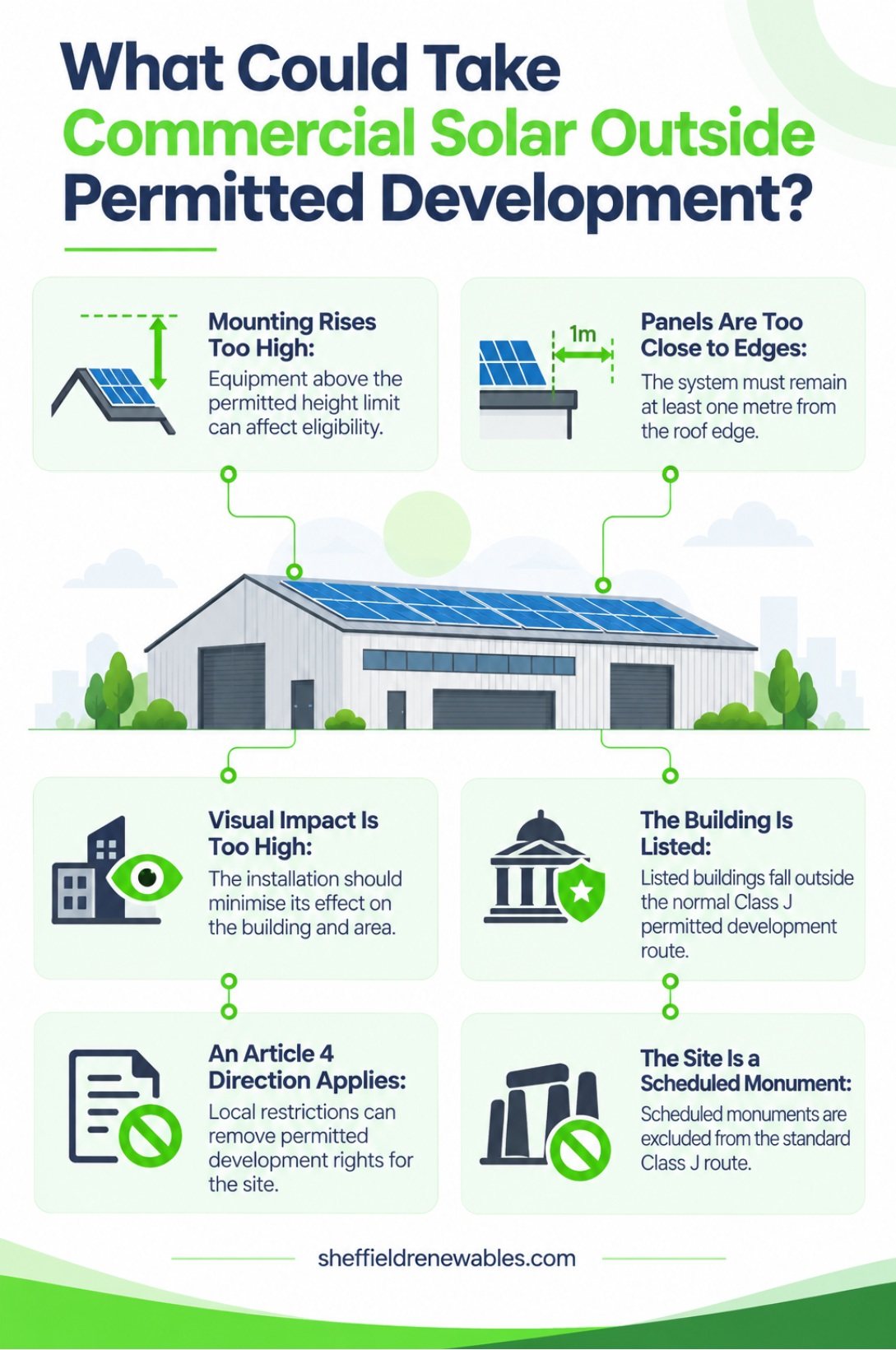
The Planning Portal guidance on planning permission for commercial solar panels sets out the key Class J requirements. These include limits on how far panels can project, how high equipment can sit above a flat roof and how close it can be placed to the roof edge.
Where those conditions are met, a full planning application is generally not required.
What Conditions Must Commercial Rooftop Solar Meet?
To qualify for permitted development under Class J, a commercial rooftop solar installation must meet specific limits relating to its height, projection, position and appearance. Small changes to the mounting method can affect whether these requirements are satisfied, so the final design should be checked carefully.
Height and Projection Limits
A flat roof installation must stay within a one metre height limit, measured from the highest part of the equipment to the highest part of the roof, excluding chimneys.
That assessment covers the complete setup rather than the photovoltaic modules alone. Rails, frames and other mounting components can affect the measured height, so the selected support arrangement matters during design.
Appearance and Removal Conditions
Qualifying solar equipment should be positioned, where practicable, to limit its effect on the building’s external appearance and the amenity of the surrounding area. The equipment should also be removed as soon as reasonably practicable once it is no longer needed.
These requirements mean the installation needs to consider both its visual impact during use and what happens when the system is no longer required.
When Do Large Commercial Solar Systems Need Planning Permission?
System size above 1MW no longer automatically takes a commercial rooftop project outside Class J. The previous 1MW limit was removed through changes made in December 2023.
The 2023 amendment to the permitted development rules removed that capacity restriction, allowing larger rooftop arrays to remain within the permitted development framework where the other requirements are satisfied.
Separate Prior Approval can still be relevant for certain larger non domestic rooftop installations. The Local Planning Authority may assess matters such as siting, design, external appearance and glare. The authority can have up to 56 days to reach a decision.
This means capacity and planning involvement now need to be considered separately. A larger array is not automatically a full planning application, although additional scrutiny can still apply.
Does a Listed Commercial Building Need Planning Permission for Solar Panels?
Yes, solar panels on a listed commercial building can require additional consent before work starts. The same can apply to solar equipment in the curtilage of a listed building or near a scheduled monument.
Listed building consent focuses on protecting the building’s architectural or historic interest. Planning permission deals with the proposed development itself. These are separate matters, so one does not replace the other.
GOV.UK guidance on conserving and enhancing the historic environment explains that listed buildings receive special protection because of their architectural or historic significance. Solar panels, mounting equipment and fixings can therefore need careful consideration before installation. Establishing the required consent early can prevent changes later in the design process.
Do Conservation Areas Affect Commercial Solar Panel Planning?
A conservation area does not automatically mean that full planning permission is required for commercial solar panels. The property still needs to be checked against the permitted development rules applying to the installation.
The 2023 changes expanded some commercial solar permitted development rights on protected land. Older guidance may therefore give an outdated picture.
An Article 4 Direction can remove specific permitted development rights in a defined area. According to the GOV.UK guidance on Article 4 directions and permitted development, a local authority can use an Article 4 Direction to require a planning application for development that would otherwise benefit from permitted development rights.
This means the conservation area itself is not the only factor to check. Any local Article 4 restrictions also need to be confirmed before the solar installation is designed or approved.
What Should You Check Before Installing Commercial Solar Panels?
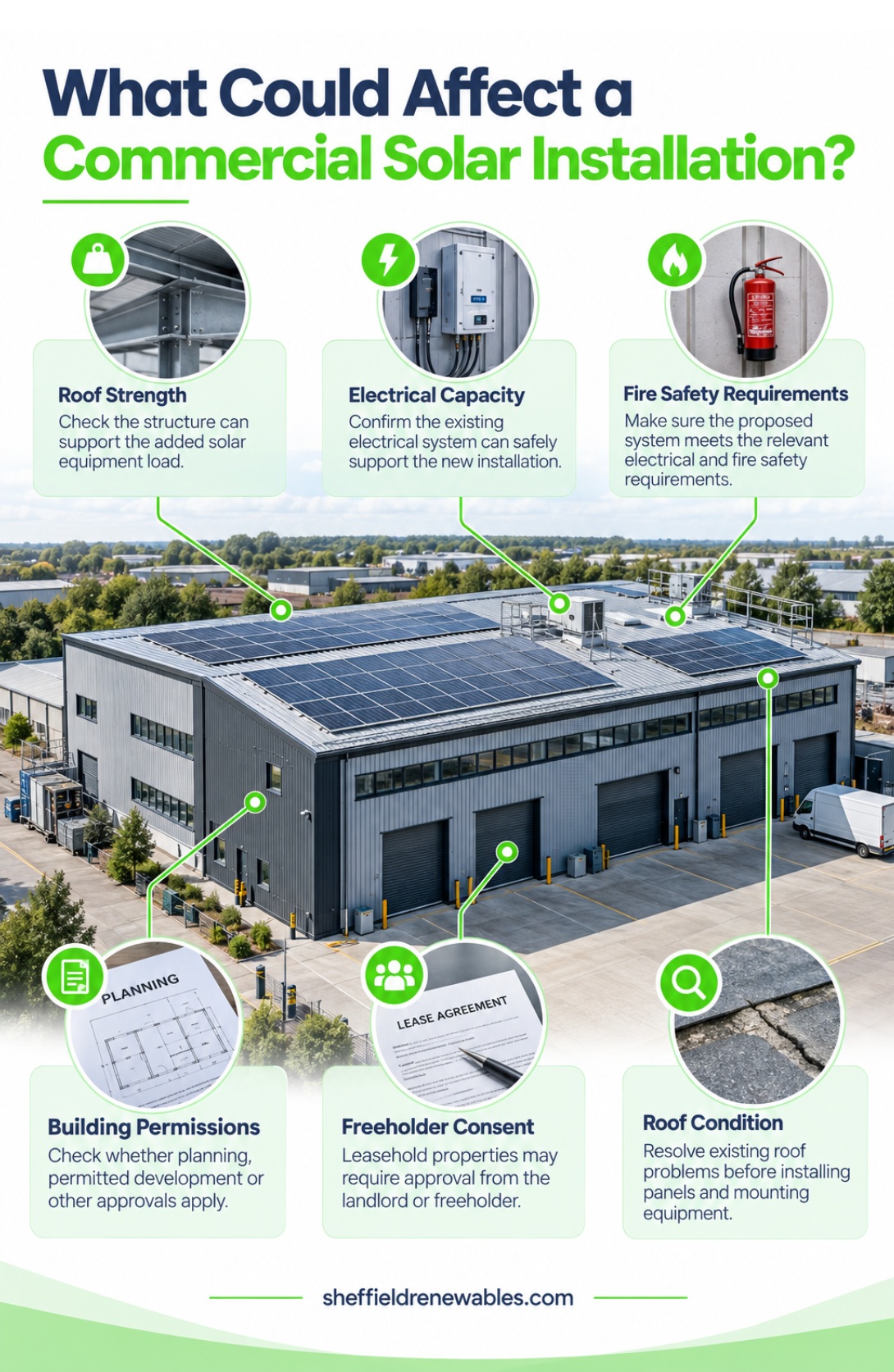
Planning permission is only one part of a commercial solar project. Other checks can still apply even when the system qualifies as permitted development.
Building Regulations and Roof Structure
The roof must support the additional loading from the solar equipment. Its condition and structural capacity should be assessed before installation. Strengthening may be required if the existing structure cannot support the proposed array.
Electrical and Fire Safety Requirements
Electrical and fire safety requirements still apply regardless of planning status. The solar system needs to meet the relevant requirements before it is commissioned.
Freeholder or Landlord Consent
A leaseholder may need consent from the landlord, freeholder or management company before installing solar panels. This is a contractual or ownership issue rather than a planning requirement.
Once these permissions are confirmed, the next step is assessing the building and designing a system that suits the property. See our commercial solar panels service for details.
What the Latest Planning Rules Mean for Commercial Solar
UK solar deployment has grown sharply in recent years. The House of Commons Library records around 1.8 million solar installations across the UK, reaching 18.1GW of cumulative capacity by March 2025. Solar PV generated 14.8TWh of electricity in 2024, which accounted for around 5% of total UK electricity generation.
Commercial rooftops still represent a relatively small share of that potential. Research published in September 2026 found that less than 10% of suitable commercial roof space currently has solar installed. That represents around 3–5GW of capacity, compared with an estimated potential of roughly 60GW across suitable commercial roofs.
That makes the 2023 removal of the 1MW limit particularly relevant to larger commercial rooftops. More projects can now use the Class J permitted development route, provided the other requirements are met.
FAQs
Can I install solar panels on a commercial roof without planning permission?
Yes, many commercial rooftop systems can be installed under permitted development if the property and proposed equipment meet the required conditions.
Do commercial solar panels over 1MW need planning permission?
Not automatically. The 1MW permitted development threshold was removed in 2023. Other conditions and Prior Approval requirements can still apply.
Do solar panels on a listed commercial building need permission?
Yes, further consent may be required because listed buildings fall outside the normal Class J route. Listed building consent may also apply.
Do solar panels in a conservation area need planning permission?
Not automatically. The planning position depends on the property, installation and any local restrictions, including an Article 4 Direction.
What is Prior Approval for commercial solar panels?
Prior Approval allows the Local Planning Authority to assess specific matters for certain developments, including design, appearance and glare. The process can take up to 56 days.
Conclusion
Commercial rooftop solar can often use permitted development in England, but the route depends on site specific conditions. Roof dimensions, property status, local restrictions and separate technical approvals all need checking before work begins. The 1MW change broadens the route for larger systems, while Prior Approval can still apply.
Not sure whether your commercial roof is suitable for solar? Get a free commercial solar quote for a site assessment and a clear installation plan.